
COMPANY NAME
PROSERVATION GmbH
COUNTRY
Germany
SECTOR
Agrifood / Retail
CIRCULAR BUSINESS MODEL
Circular supply chain, Circular product design
CHALLENGE
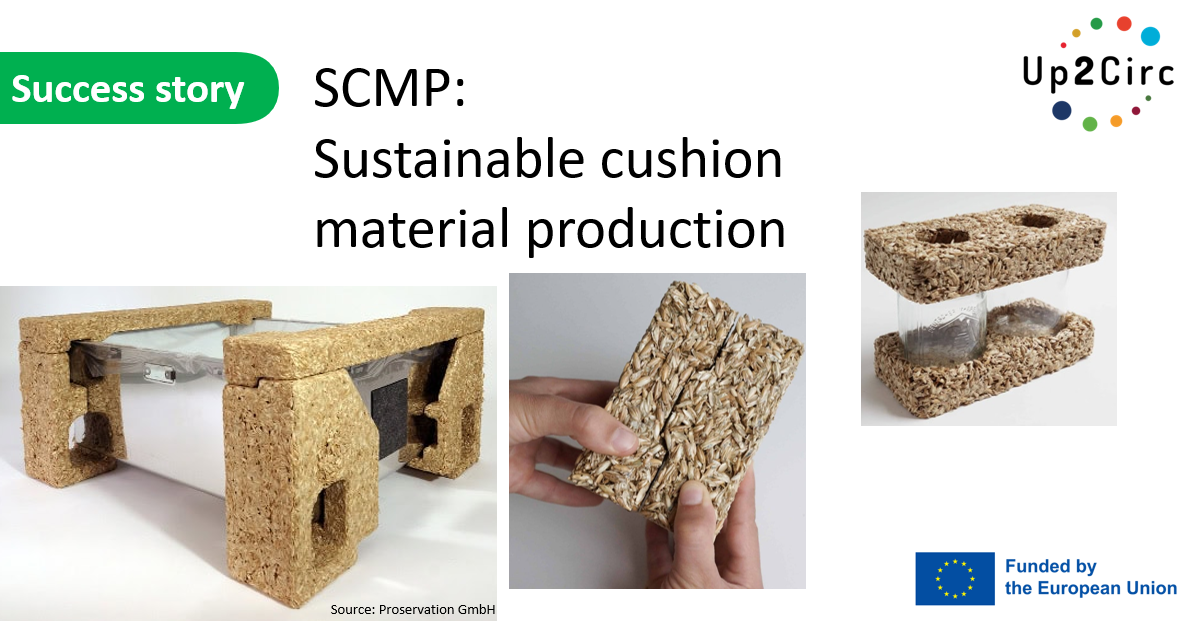
Packaging materials are often not particularly environmentally friendly. Especially, when it comes to cushioning products to prevent breakage, materials such as Styrofoam are frequently used, which are barely biodegradable or not at all. The company PROSERVATION has developed a material made from grain waste that can replace environmentally harmful packaging materials. This new material is called RECOU and must first be shaped using negative molds. These negative molds are currently not made from the ideal material. They cannot be used very often and lack recycability potential.
SOLUTION
It is important that the material used for these negative molds has a low carbon footprint, is cost-effective, and can be reused multiple times. Goal of the project was to identify and test diverse materials for negative molds.
CIRCULAR ECONOMY STARTEGY/BUSINESS MODEL IMPLEMENTED
Throughout the project, the following principles of the circular economy were successfully implemented:
– Narrowing resource loops: By redesigning mold production with more sustainable materials, the project reduced material intensity and environmental impact. Resource-efficient mold compositions and targeted material use contributed to a lower ecological footprint.
– Slowing resource loops: The durability and reusability of the negative molds were significantly increased—from an initial 50–100 cycles to a projected 1,000 cycles. This tenfold improvement reduces the need for frequent mold replacements, resulting in a more stable and less resource-intensive process.
– Closing & Regenerating resource loops: All RECOU packaging components—including grain husks and the organic binder—are fully biodegradable and compostable. After use, they reintegrate into natural material cycles, avoiding waste and supporting soil health through
composting. By transforming regional agricultural by-products like spelt husks into high-value packaging, the project fosters regenerative material flows. This approach not only prevents agricultural residues from becoming waste but also enhances local value creation and reduces reliance on fossil-based packaging materials.
IMPACT
From an ecological standpoint, aluminum is a relatively sustainable choice since it is almost 100% recyclable without any significant loss of quality. Compared to many other metallic materials, it also has a favorable environmental footprint, particularly when secondary aluminum (recycled material) is used.
By extending the lifespan of molds by a factor of 10, material consumption and associated production processes have been drastically reduced. This leads to fewer raw material deliveries and less frequent mold production, both of which contribute to a significant reduction in greenhouse gas emissions.
Additionally, the use of recyclable materials like aluminum ensures long-term sustainability
and alignment with the EU’s “Fit for 55” targets.
The extended durability of the molds leads to a drastic reduction in material consumption. While one new mold was required for every 100 production cycles in the past, now only one mold is needed per 1,000 cycles. This equates to a 90% reduction in material volume, making
a substantial contribution to resource conservation.
Social impact:
Socially, the increased scalability and process stability open up new market opportunities and strengthen the long-term competitiveness of the company. This creates potential for job security and growth, aligning with SDG 8 by decoupling economic growth from environmental
degradation.
KEY TAKEAWAY
The Up2Circ-Project was successful, as the most relevant material alternatives were thoroughly examined and compared with regard to their economic, ecological, and processrelated performance criteria. In summary, the CNC-milled mold offers the strongest technical performance, with excellent dimensional stability, thermal resistance, and surface quality, making it well-suited for long-term, high-quality production. However, CNC molds also exhibit the highest environmental footprint. This reveals a clear trade-off: CNC tooling delivers superior durability and reliability, but at higher ecological and financial cost. To define its economic and environmental justification, the break-even point—where its benefits outweigh its drawbacks—must be determined
through long-term, real-world testing.