
Company name
siebold/hamburg messebau GmbH
Country
Germany
SECTOR
Construction
CIRCULAR BUSINESS MODEL
Product life extension / Circular product design
CHALLENGE
Trade show construction leads to a lot of waste and inefficiency. Every exhibitor seeks a booth on site that should be unique and
individual. Unfortunately, in many cases this approach is also costly and unsustainable considering the usage of many
different materials with worldwide transports. Additionally these trade show appearances are always quite temporary.
SOLUTION
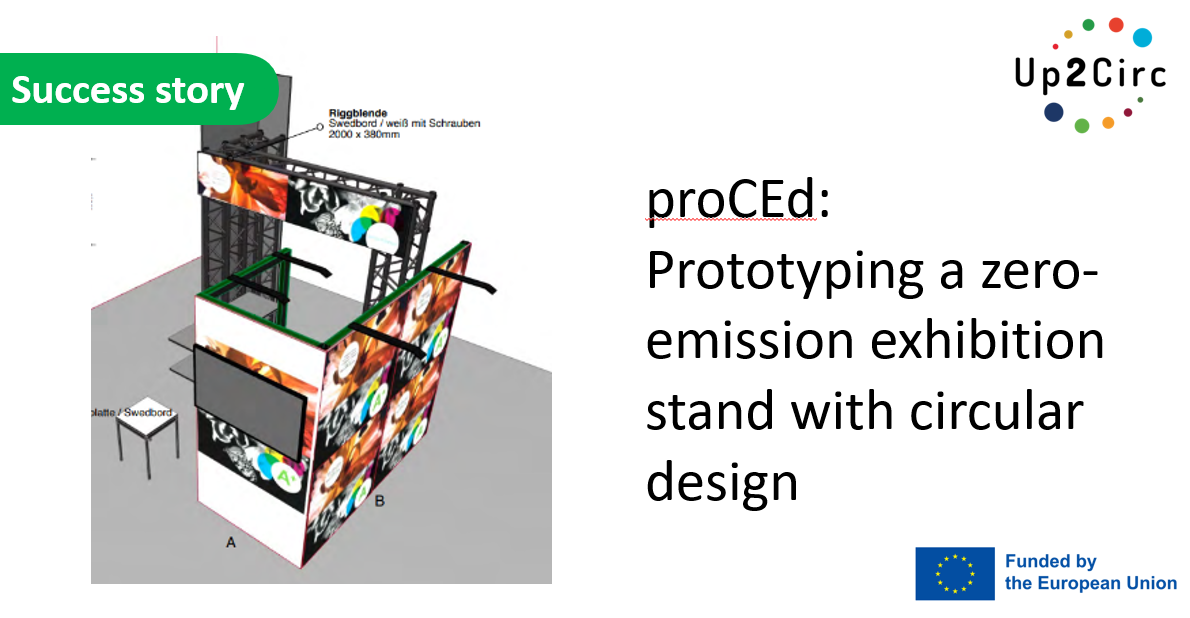
The goal was to develop trade-fair stand designs that align with circular economy principles, to systematically evaluate materials for zero-emission stands and maintain an inventory of furniture and premade elements for future projects. Within the project duration a prototype for a marketable, low-waste, and zero-emission booth has been designed and created. Material loops needed to be closed, waste and weight minimized and logistics streamlined. Additionally, own decision-making processes needed to be adjusted by creating internal guidelines that exceed sustainability and environmental responsibility expectations. For example, a catalog of environmentally friendly construction materials has been set up. In order to lower the product’s and services’ CO2 footprint even further, it was explored how furniture may be rented on-site to further decrease weight, minimize waste at exhibition sites and avoid non-recycling materials. Customers will be involved in the process and offered incentives to create a sense of community. The waste at exhibition sites that cannot be avoided need to be reintegrated in other materialdesigns or processes.
CIRCULAR ECONMY STRATEGIES/BUSINESS MODEL IMPLEMENTED
Waste is already created in the design phase of a product. This is why circularity needs to be included in the very early stage of planning and communication with customers. The decision-making within existing processes, products and services therefore needs to be checked in-depth with regard to sustainability, recycability and re-use of elements and materials.
IMPACT
A direct outcome of the project is a new business offer: the zero-emission and circular exhibition booth. This offer leads to calculatable impact, the reduction of CO2-emissions. Very specific, the developed circular booth type A has a CO2 footprint of 0,760t. With this prototype CO2-emissions were reduced by 90% compared to the status before the project. When it comes to waste reduction this booth type consist of only 4,6% single use materials, which is a reduction of waste by 94%. We were surprised that we were able to achieve such an immense numbers with a further development of our current practice, which is absolutely feasible and realistic after testing it in the prototype and implementation discussions. There was no need to completely reinvent the product. We simply had to optimize it according to sustainability criteria and put it to the test.
KEY TAKEAWAY
The next steps are now to implement the new strategies and new knowledge on a large scale in day-to-day business and in all areas. This will be accompanied by joint further development and testing through feedback, questioning, documenting, evaluating and trying out new ideas, such as the use of other materials. We are looking forward to this new developments, since feedback from stakeholders and partners is very positive!