
COMPANY NAME
Ocean Material
COUNTRY
Germany
SECTOR
Mobility, Transport, Automotive
CIRCULAR BUSINESS MODEL
- Circular supply chain, Product life extension, Recovery and recycling
CHALLENGE
Many pallets are still made of wood, which is increasingly viewed critically, but not critically enough. These pallets are very limited when it comes to lifetime and they are heavy. Depending on how they are used in practice, the CO₂ bound in this wood is often only stored for a relatively short period – sometimes just a few months and rarely more than a few years – before damaged pallets are downcycled or burned. Simultaneously there are plastic manufacturers who have a lot of internal production waste and would like to put this waste back on the market instead of having to dispose of it. Plus, plastic recyclers who have far too many plastic mixtures in stock and are struggling to find the right buyers for these individual plastic mixtures.
SOLUTIONS
We as Ocean Material try to connect all these sectors and turn it into something positive, lightweight, high-quality pallets. The material – plastic – causes many problems around the globe, but it is already here. Instead of burning plastic or dispose it as waste, we have the opportunity to circulate it much more often. So, how could contaminated and low-value marine plastic be processed in a technically robust and energy-efficient way? We developed a recycling machine and process collaboratively, combining engineering expertise with practical insights from global material streams.
As our work progressed, we also realised that developing a recycling machine alone would not be sufficient. We therefore expanded our approach to include a platform that integrates environmental data, material specifications and communication aspects. With the support of an experienced advisor from BlueInvest, we were introduced to the EU-funded Up2Circ programme. Within this framework, we identified logistics pallets as a promising niche application and addressed a central question: how can pallets be effectively returned and recycled in practice? This question was explored in depth during the six-month project.
CIRCULAR ECONOMY STRATEGIES
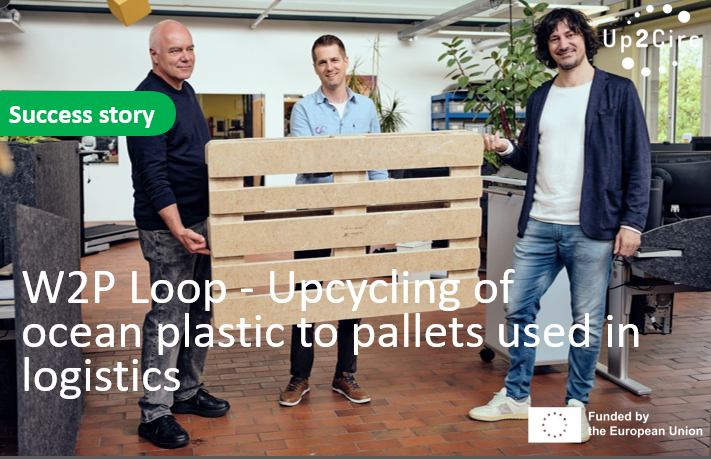
The project “W2P Loop: Closed-Loop Reverse Logistics System for Sustainable Pallets” assessed the feasibility of implementing a circular return system in logistics. The special environmental value is added by using our patented Waste-to-Product technology, which upcycles complex, economically unrecyclable plastic waste from the ocean into lightweight, high-performance composite pallets, primarily applied to logistics load carriers. The outcome was a decision-ready feasibility study defining viable return-system architectures, success metrics, and a go/no-go framework for future pilot implementation and scaling. This is where we are right now.
IMPACT
Environmental impact
The analyses showed that using our pallets made from recycled plastic, saves around 20,000 tonnes of CO2 per year compared to wooden pallets. This is mainly because they are lighter and can be used for much longer. Our production process enables us to avoid and/or recycle at least 8,000 tonnes of waste per year, and our decentralised system also contributes to greater energy efficiency.
Compared to conventional pallet systems, including wood-based pallets, our pallets made from recycled marine plastic show significant savings potential. Preliminary assessments based on weight and logistics considerations indicate that energy demand could be several times lower. These estimates are derived from scenario modelling and will be further refined and validated in future pilot phases.
Economic impact
We now have a first, model-based understanding of the return rate of our pallets, as this is essential for the business model. This data increases overall predictability and therefore improves the robustness of the business model. In addition, based on return flows and transport savings, we can estimate a system-level improvement in energy efficiency of around 30%.
KEY TAKEAWAY
Our experience in this field has taught us that, in the circular economy, the same thing does not always have to be created from the same thing. That was my initial assumption: how can a dirty plastic bottle be turned into a new, clean plastic bottle? While this is certainly desirable, it is not always as effective as it may seem at first glance. Such approaches can result in very limited and narrow product cycles.
What helped us was broadening our perspective and clarifying what we are actually trying to achieve: keeping materials in use. This does not necessarily mean that materials always have to be used in exactly the same way. Plastic from a drinking bottle, for example, could be used as packaging in its next life. From our perspective, the sustainability of the business model needs to be considered from the very beginning. Thinking about which material cycles exist, how large they can be, and which applications certain materials are best suited for is part of the innovation itself.
For those who are new to this type of business, the complexity of circular systems can be overwhelming at times. What helped us was to view the project as a long-term vision rather than a single, clearly defined milestone. A balance between flexibility and structure proved to be essential. Perhaps this insight can also support other entrepreneurs who are considering entering the circular economy.