
COMPANY NAME Redopapers
COUNTRY Belgium
SECTOR B2B Circular Stationery
CIRCULAR BUSINESS MODEL Recovery&recycling, product life extension
CHALLENGE
Companies across Belgium generate significant volumes of high-quality residual paper, branded letterheads, printed posters, outdated maps, exhibition materials, misprinted publications, that are routinely sent directly for recycling or disposal, despite retaining strong material value.
This represents a missed opportunity in three dimensions:
- Environmental: Premature recycling skips the reuse step, wasting the energy and resources already embedded in the material.
- Commercial: Companies have no accessible service to convert their own waste into branded circular products.
- Communicative: Organisations increasingly want to demonstrate, not just claim, circular action, but tangible reuse products are largely absent from the market.
The key question was: can a demand-driven B2B reuse service be technically feasible, operationally manageable, and commercially viable at scale?
SOLUTION
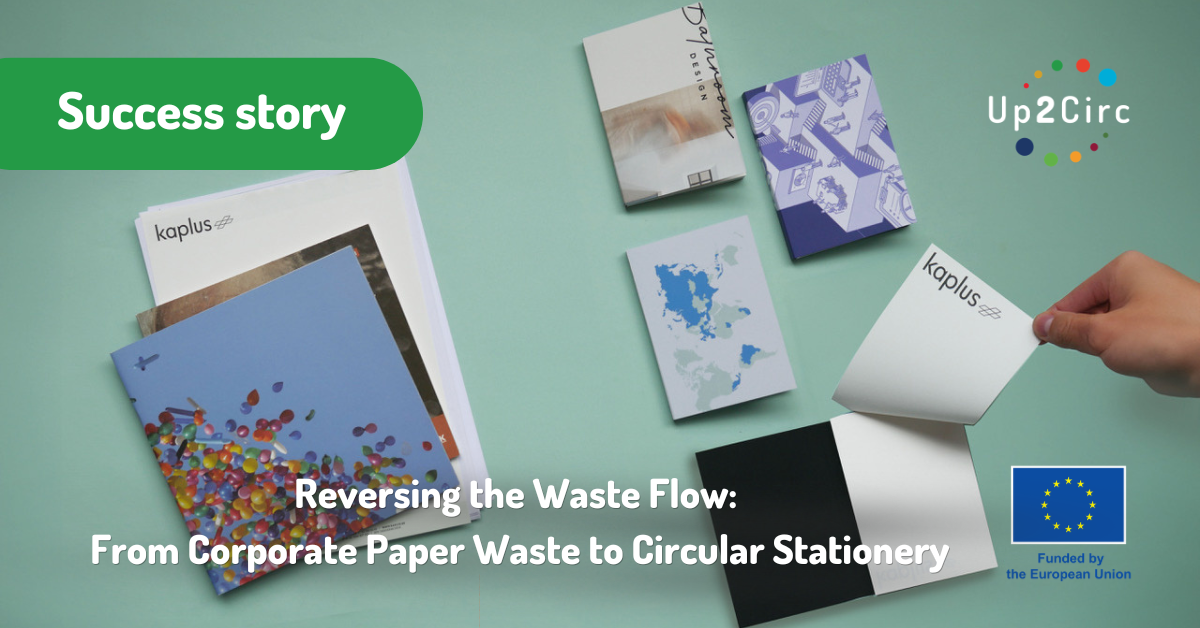
Redopapers developed and validated a circular B2B reuse service that collects company-specific residual paper and transforms it into personalised, branded stationery products, primarily tear-off planners and notepads, before the material reaches the recycling stream.
Through the Up2Circ-supported project ‘Reversing the Waste Flow’, Redopapers:
- Surveyed 183 organisations to validate market demand and willingness to pay.
- Defined technical intake criteria (paper grammage, format, print quality) for reusable residual streams.
- Developed a hybrid production model combining machine-based cutting/printing with manual assembly by social work enterprises.
- Executed pilots with 9 organisations, municipalities, hospitals, cultural institutions and companies, each receiving personalised products made from their own paper waste.
- Consolidated findings into a validated business plan and scaling roadmap.
The service is priced at €3–10 per item depending on volume and customisation, with a break-even at 2,000 units/month at €4/unit.
CIRCULAR ECONOMY STRATEGIES / BUSINESS MODEL IMPLEMENTED
- Narrowing loops: Optimised reuse intake criteria reduce dependence on virgin paper by ensuring only high-quality residual streams enter the process.
- Slowing loops: Residual paper is diverted from premature recycling and given a meaningful functional second life as durable office products.
- Closing loops: A regional reuse ecosystem is established, reintegrating corporate waste into new products within the same local value chain.
Regenerating value: Inclusive employment through social work enterprise partnerships creates local jobs while delivering measurable environmental benefit.
IMPACT
Environmental impact
- 1,535 kg of paper reused across 9 pilot organisations (target exceeded: +53.5%)
- 38,375 litres of water saved (target exceeded: +53.5%)
- 2,624.85 kg of CO₂ avoided (target exceeded: +74.9%)
- Aligned with SDG 12 (Responsible Consumption), SDG 13 (Climate Action) and SDG 7 (Clean Energy)
Economic impact
- Average gross margin of 1.5% achieved at pilot scale; projected 10–15% at commercial scale
- Customers demonstrated willingness to pay a 60–62% premium over conventional products
- Revenue forecast: €60K–€100K (2026), €135K–€220K (2027), €250K–€400K (2028)
- Break-even: 2,000 units/month at €4/unit (€8,000/month revenue)
Social impact
- 2–3 FTEs engaged in social work enterprises for manual assembly and finishing (SDG 8)
- 7 out of 9 organisations linked the product to internal communication or corporate gifting
- Strong employee engagement reported across all pilot organisations
KEY TAKEAWAY
Redopapers demonstrates that a demand-driven reuse service for company-owned paper waste is technically feasible, commercially promising and socially impactful, provided clear intake criteria, minimum order volumes and consolidated logistics are in place. The circular model delivers measurable environmental results while creating a tangible, emotionally resonant product that strengthens corporate sustainability narratives from the inside out.