
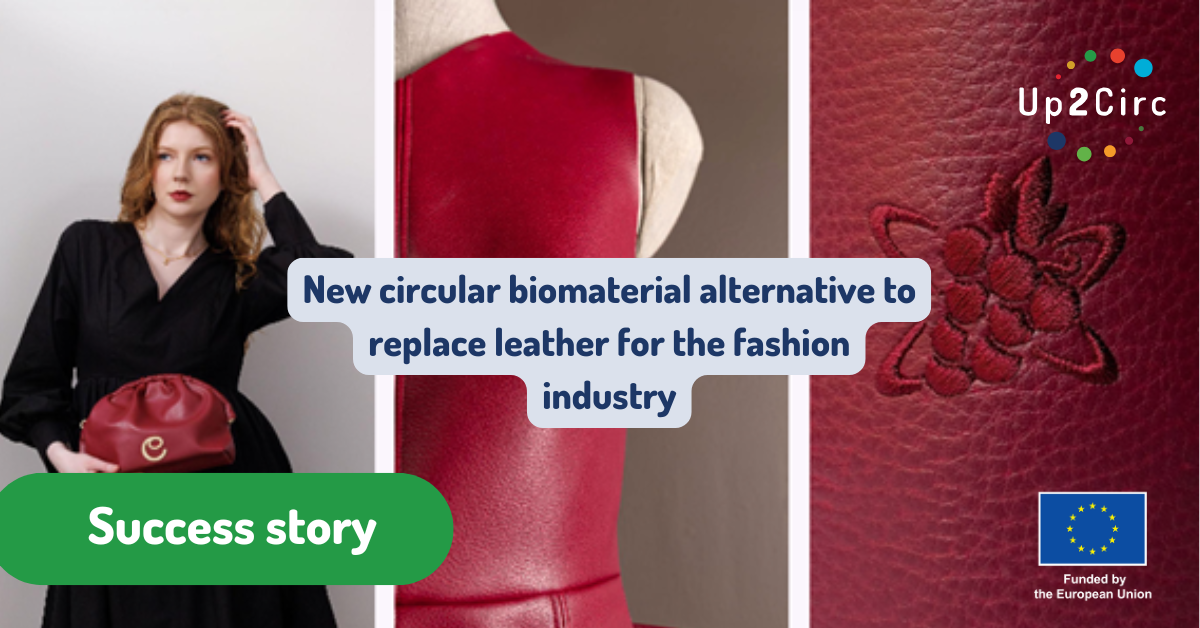
This French company collects organic grape marc direct form winemakers in Provence (South of France) and transforms it into next generation biomaterials. The grape based biomaterials are made with grape marc sourced directly from organic and biodynamic vignerons in Provence ensuring full traceability and a radically short supply chain.
COMPANY NAME
Planet of the Grapes
COUNTRY
France
SECTOR
Cultural and creative industries (Fashion)
CIRCULAR BUSINESS MODEL
Circular supply chain
CHALLENGE
The fashion industry continues to rely on environmentally harmful materials, particularly exotic animal skins such as reptile leather and 100% petroleum synthetics.
As a new-generation biomaterials company, our challenge is to provide a compelling, measurable alternative made partly with agricultural waste specifically grape marc from the wine industry, combined with natural regenerative resources.
The challenge is to prepare industrialisation of the solution with a pilot, as well as improve the processes and methods to improve their life cycle footprint.
SOLUTION
Planet of the Grapes is building a circular solution for the fashion industry—one that transforms local agricultural waste into high-value, sustainable alternatives to animal and synthetic leather.
They have actualized their innovative circular pilot to include more winemakers, worked on the processes (collection, transportation etc.) and the circular grape technology (% of biobased materials).
IMPACT
Economic : Successful developpement of a 50% grape marc content material, 4 winemakers involved
Environmental: 17,128 litres of water are used for a leather tote bag, according to Collective Fashion Justice, they use under 8 litres and in a closed loop process. 80kg/CO2eq/m2 is formed during the whole process of making a leather tote bag from animal to end product and ours is 9kg/CO2eq/m2, according to Cornell University. It also reduces transport emissions.
Social : This local-first approach allows to strengthen regional partnerships with local jobs, and foster transparency at every stage of production at the benefice of the companies and the customers.
KEY TAKEAWAY
By desining for circularity from the ground up, they are turing waste into high-value biomaterials for the fashion industry. Thanks to Up2Circ program they were able to do this at scale are now commercial.