
COMPANY NAME
Fájdalom-ambulancia Szolgáltató Korlátolt Felelősségű Társaság
COUNTRY
Hungary
SECTOR
Proximity & Social Economy
CIRCULAR BUSINESS MODEL
- Recovery and recycling
CHALLENGE
Energy costs are a major expense when operating large facilities. This includes, for example, heating costs in fitness centers. Dependence on fossil fuels and increasing market volatility sometimes pose risk factors in this industry. However, new technologies offer alternatives. These should be tested in this project as part of a feasibility study.
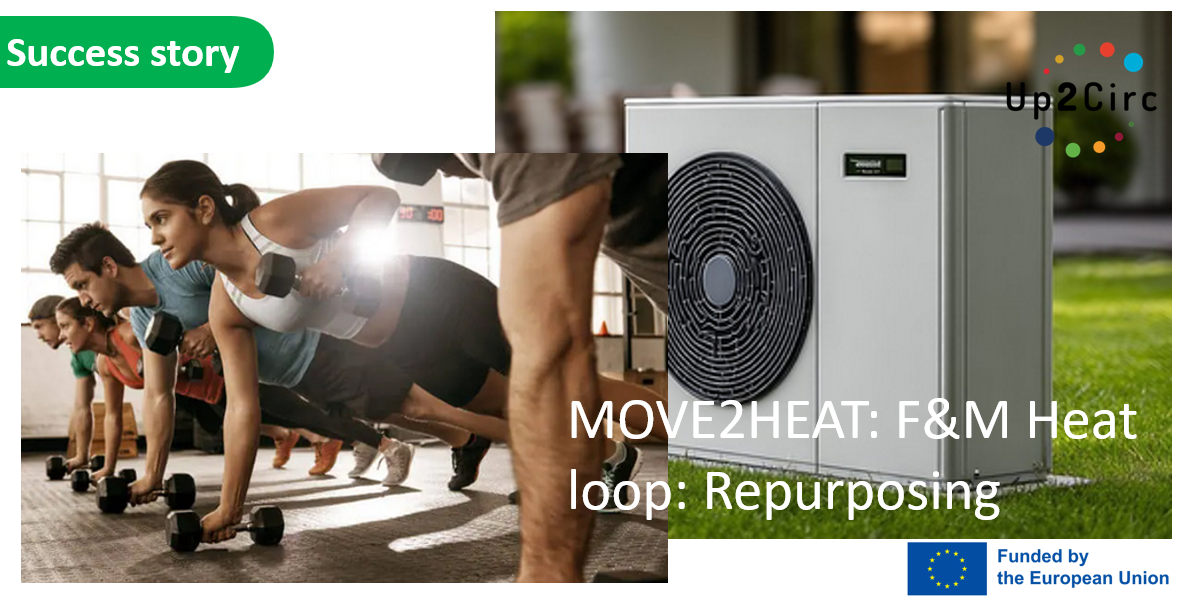
When people work out in a fitness studio, their bodies release heat into the surrounding environment. The question is whether this heat can be captured and utilized with the help of modern heat pumps in a way that allows the owner to make use of it.
SOLUTION
It was tested and explored if the “waste” heat generated by gym users and the facility’s internal environment — previously vented into the atmosphere— may be used as the primary energy source for water heating, creating a closed-loop energy cycle. By moving from electric boilers to a heat pump, it could be proved that the energy loop can be significantly narrowed. The system reduces external electricity consumption for by 121,196 kWh per year, a nearly 75% reduction in resource intensity.
The transition from high-carbon intensity heating to a waste-heat recovery system results in an annual reduction of 64,437 kg of CO2. This supports the regeneration of the local environment by decreasing the facility’s total carbon footprint and thermal pollution.
CIRCULAR ECONOMY STRATEGIES/BUSINESS MODELS IMPLEMENTED
Instead of ventilating the generated heat from multiple bodies into the air/atmosphere, it was possible to proof that this heat can be used within the facilities and lower the CO2 footprint and energy consumption significantly. A further sucessful step towards a closed loop system.
IMPACT
The feasibility study proved that our approach can entirely cover 100% of the domestic hot water (DHW) demand for 144 days a year and provide partial heating for another 176 days. Catchy value proposition: This specific metric—that a facility can essentially run its hot water “for free” (via waste recovery) for nearly half the year—is a powerful marketing tool. It drives customer interest through the “Your effort powers your shower” message and ensures high uptake potential among other urban fitness centers looking to decouple from rising energy prices. The approach is not only economical but also ecological sustainable.
KEY TAKE AWAY
Given that Budapest alone hosts approximately 250 to 300 gyms, the market potential is vast. We are moving from a single-site pilot toward a general marketing and rollout strategy. The project team is currently developing an adaptable assessment tool. This scale will allow us to input the basic parameters of other gyms (daily visitor count, current HVAC system type, and utility costs) to determine a “ballpark” ROI and energy saving potential without requiring a full 6-month study each time.