
COMPANY NAME Bim Trading Ltd
COUNTRY: Cyprus
SECTOR: Construction
CIRCULAR BUSINESS MODEL: Product as a service (Paint-as-a-service Lite)
CHALLENGE
The construction sector in Cyprus currently operates under a linear “dispose-and-replace” model. Surplus water-based paints and high-quality HDPE/PP packaging are routinely landfilled or incinerated, resulting in the permanent loss of valuable resources such as pigments and polymeric binders. This is compounded by the fact that Cyprus has no domestic pigment production and relies entirely on imported raw materials to supply a coatings market estimated at €41.8 million annually. High-value components like titanium dioxide (TiO2), which can make up 25% of paint by weight, currently cost between €2,600 and €3,000 per tonne to import.
SOLUTION
Bim Trading Ltd transitioned from a conventional distributor to a circular economy provider by validating a “Paint-as-a-Service Lite” model. The project established a localized return-and-reuse loop where professional contractors are incentivized through discounts to return leftover paint and empty buckets.
Technically, the project validated a rigorous three-step recovery process to transform liquid waste into high-value powder:
- Ultrafiltration: A pressure-driven process that removes 70-80% of water while preserving the chemical functionality of polymer binders.
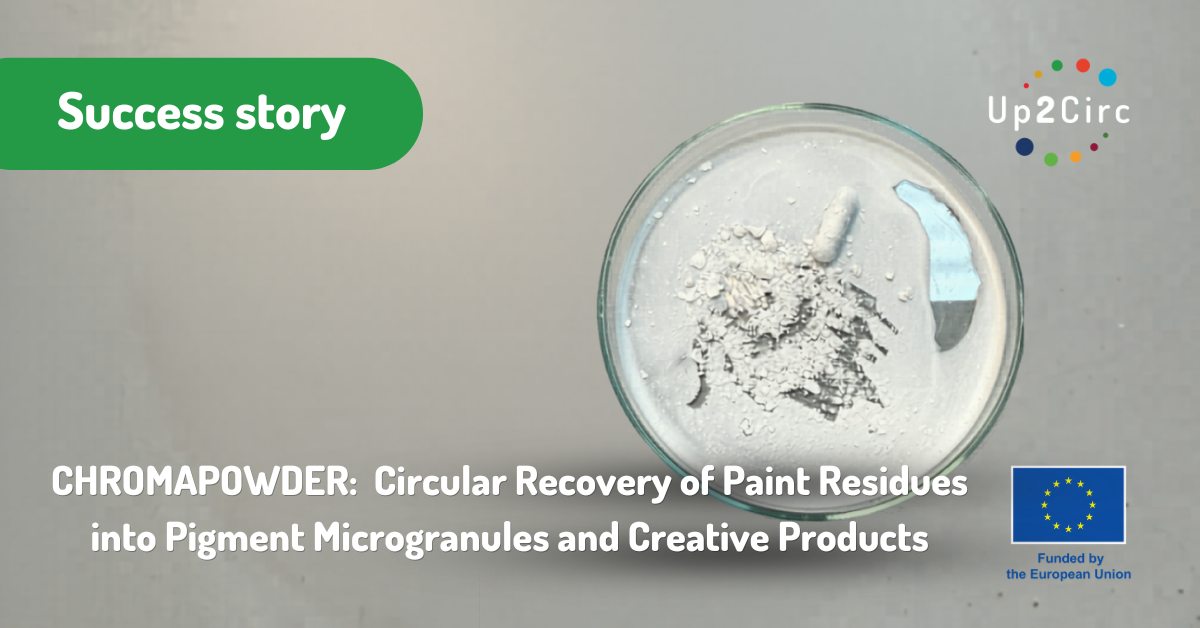
- Spray Drying: Converts the concentrated slurry into stable, spherical, and flowable microgranules.
- Jet Milling: Uses supersonic air-jets to cause particle-particle collisions, ensuring a narrow particle size distribution (1–10 microns) optimized for B2B industrial applications like colored concrete.
The integrated system is currently rated at TRL 5-6 (Technology Demonstrated in a Relevant Environment).
CIRCULAR ECONOMY STRATEGIES/BUSINESS MODEL IMPLEMENTED
Narrow (Efficiency): By selecting Ultrafiltration over thermal evaporation, the process reduces energy demand by 70-80% because it relies on hydraulic energy rather than the latent heat of vaporization.
Slow (Durability): The project validated that HDPE pails possess the mechanical durability to survive 10+ reuse cycles, effectively extending the material’s functional life.
Close (Recycling): Material loops are closed by transforming residues into a pigment-rich secondary raw material, substituting energy-intensive virgin pigments like imported TiO2.
Regenerate (Safe Material Flows): A toxicological screening of Safety Data Sheets (SDS) ensured that only non-hazardous “Cool Barrier” streams are regenerated into the construction supply chain.
IMPACT
Environmental impact:
• 1,206 kg/year of paint and packaging waste diverted from disposal.
• ~3,300 kg CO2e/year in avoided emissions through diversion and bucket reuse.
• 77% carbon reduction potential for packaging through the reuse cycle.
• 238 kg/year of virgin polypropylene substituted via reuse.
Economic impact:
• €2.25 circular value generated per returned bucket.
• €4/kg contribution margin on recovered pigments (based on a €10/kg B2B sales price).
• €1.50 saving per bucket through cleaning and reuse versus purchasing new units.
Social impact:
• 75% survey response rate from professional contractors, indicating strong industry interest.
• 100% of respondents with definite interest motivated by practical site pickups and scheduled collections. • Enhanced workplace safety and circular skills through the definition of new Standard Operating Procedures (SOPs) for staff.
KEY TAKEAWAY
The CHROMA project demonstrates that a circular “Paint-as-a-Service Lite” model is both technically viable and economically self-sustaining for SMEs. By capturing the internal value of recovered pigments and packaging, a waste management cost is successfully transformed into a secondary raw material stream, allowing the company to fund contractor incentives while reducing Cyprus’s reliance on expensive, energy-intensive imports.