
COMPANY NAME
Studio Belize GmbH
COUNTRY
Germany
SECTOR
Textiles / Retail
CIRCULAR BUSINESS MODEL
Circular product design / Circular supply chain
CHALLENGE
Before the Up2Circ project, the company followed a linear business model from production to stock. Materials are sourced in Asia where the shelves are also produced and than shipped to a warehouse in Germany. This causes sustainability challenges. Logistics cause high CO2 emissions & indirect GHG emissions (Scope 3 upstream). Inefficiency is caused by overproduction and unnecessary storage. The shelves were neither modular, biodegradable, nor enabled for 2nd lifecycle services. Repair, refurbishing, remanufacturing or recycling were not foreseen.
SOLUTIONS
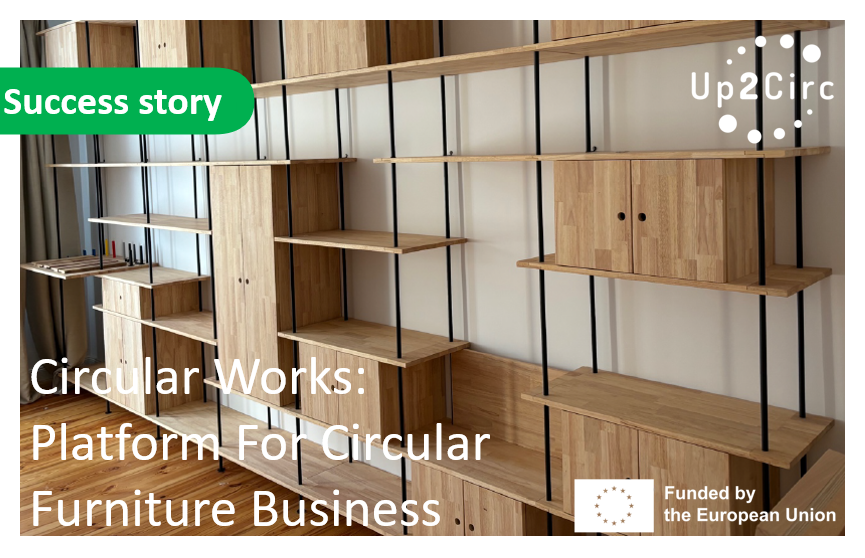
A modular shelve prototype, developed in collaboration with partners in Thailand and finalized in Berlin, that is both technically and aesthetically viable for serial production commited to longevity, flexibility, and second-lifecycle usability. The use of reclaimed rubberwood, a material that naturally aligns with circular production methods, reinforces environmental goals and supports SDG 12 and 13 by reducing CO₂ emissions and waste. At the same time, the collaboration with European carpenters lays the foundation for a regional production network, which will not only shorten supply chains but also strengthen local craftsmanship and green value creation across the EU. Last not least an online configurator enables a production-on-demand approach. This way furniture does not need to be stored and overproduction is avoided.
CIRCULAR ECONOMY STRATEGIES/BUSINESS MODELS IMPLEMENTED
Circular product design: Modular design, so that single parts may be easily exchanged, repaired and used for different objects.
Circular supply chain: Using reclaimed rubberwood, a dead side product in rubber production provides this material with new value and keeps in in use. The on-demand production further circularises the supply chain by avoiding overproduction and storage costs.
IMPACT
On an economical level we have a new product offer and extended value chain. Further material costs were reduced by using rubberwood, as a by-product of the latex production.
Ecologically, since rubberwood is usually discarded once it can no longer produce latex, by repurposing it, all CO2 emissions from the disposal process are eliminated. This reduction lowers the material-related CO2 emissions from approx. 70% to an estimated 35%.
From a social perspective it may be stated that producing in the EU comes with these social benefits: job creation, improved working conditions, high social standards, environmental sustainability, community development and innovation. These impacts contribute to a higher quality of life for workers and communities, contributing to economic stability and social cohesion.
KEY TAKE AWAY
The Up2Circ project has laid the groundwork for Studio Belize GmbH’s future growth as a circular design company. By merging sustainable furniture production with digital customization and local craftsmanship, the company is well positioned to pioneer a new generation of responsible design.