
COMPANY NAME
toern GmbH
COUNTRY
Germany
SECTOR
Digital/Retail
CIRCULAR BUSINESS MODEL
Product Life Extension
CHALLENGE
Returns in e-commerce, particularly in the Home and Living sector, do have significant financial and environmental impact. Returns in e-commerce are costly, with expenses reaching up to €20 per return and releasing approximately 1,8Kg of CO2 per return. The main issues include additional transport routes, packaging waste, and manual effort required for inspection and processing of returned items.
SOLUTION
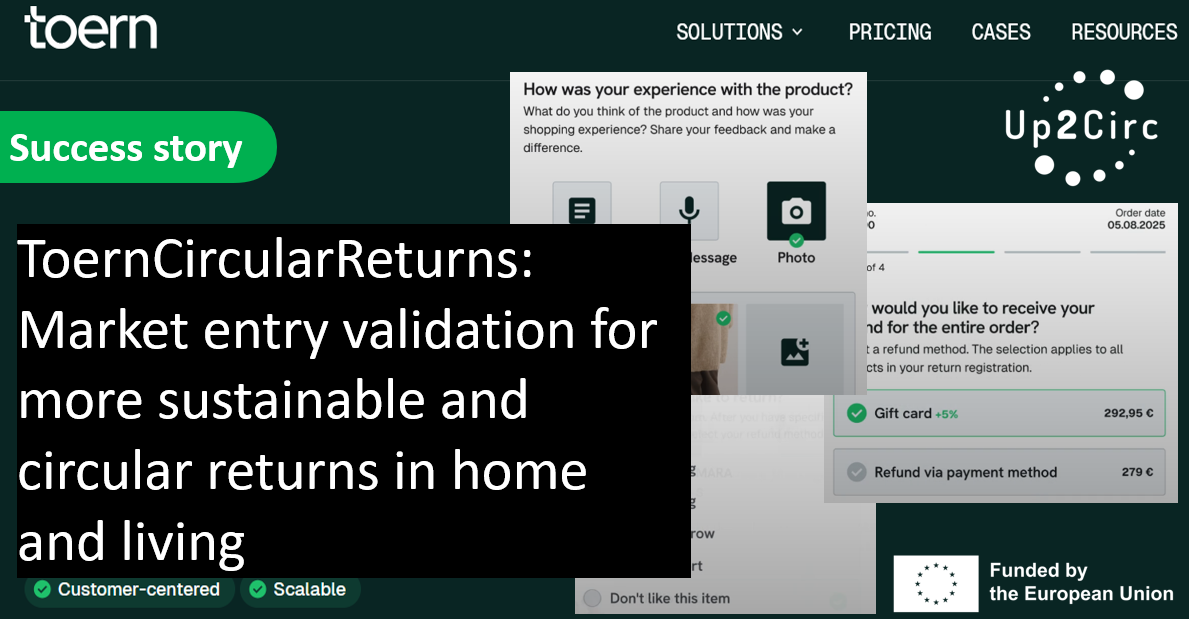
To address the challenge of costly and environmentally harmful e-commerce returns toern GmbH explored if their existing SaaS solution from the fashion sector may be applied for the Home and Living sector. This solution enables online stores to forward returned items directly to other customers, rather than sending them back to return centers. The key features of the solution include:
- Quality Assurance at the Returner’s Location: Using AI-driven image classification and data models, the solution conducts quality inspections of returned items at the returner’s location. This allows for informed decisions about the optimal handling of returns.
- Direct Forwarding: Like-new items can be directly forwarded to the next customer, while items requiring refurbishment can be sent to repair services or return centers without unnecessary detours. This reduces transport routes, packaging waste, and resource consumption.
- Digital Inspection for Home and Living Items: The project will explore whether the existing AI models for fashion items can be adapted for Home and Living items or if new models need to be developed. This includes assessing the feasibility of digitally inspecting larger items and those requiring two-person handling.
- Market Research and Feasibility Study: The project will conduct market research, stakeholder interviews, and feasibility, desirability, and viability testing to determine the economic and ecological potential of implementing the solution in the Home and Living sector.
By implementing this solution, toern GmbH aims to create a more sustainable and circular returns process, reducing waste, emissions, and costs in the Home and Living e-commerce sector.
CIRCULAR ECONOMY STRATEGIES/BUSINESS MODEL IMPLEMENTED
By adapting the business model towards the home and living sector, the company serves the circular economy strategy “Product life extension”. Unfortunately, large numbers of home and living items ordered online are destroyed when customers are not satisfied with their order and send these items back. Transport and quality check of these items are too cost intensive for many companies. Sending items directly to the next customer therefore extends the product life.
IMPACT
Over the course of the project, it was technically demonstrated that even large-volume products such as furniture can be digitally inspected in a decentralized manner at the customer’s location, with the results automatically evaluated using AI support.
From a commercial perspective, this approach offers the potential to significantly reduce return costs, storage requirements, and customer support efforts—while simultaneously enhancing customer satisfaction.
From an ecological standpoint, avoiding unnecessary returns contributes to a noticeable reduction in packaging waste and CO₂ emissions.
Socially, the approach increases transparency for end customers and provides them with a convenient solution for handling damaged items—without the need for return shipping.
The originally intended peer-to-peer use case proved economically unviable in the Home & Living segment. In contrast, the alternative use case for digitally processing defect cases through the SmartKeep workflow shows clear economic potential. It enables a significant reduction in replacement shipments, storage costs, and customer support efforts. As a result, the approach contributes both to lowering operational costs and improving customer satisfaction.
KEY TAKEAWAY
Even if the peer-to-peer approach is difficult to implement for bulky goods from Home and living sector, an alternative and highly relevant use case was identified: SmartKeep workflow – the digital handling of defect cases directly at the customer’s location.