
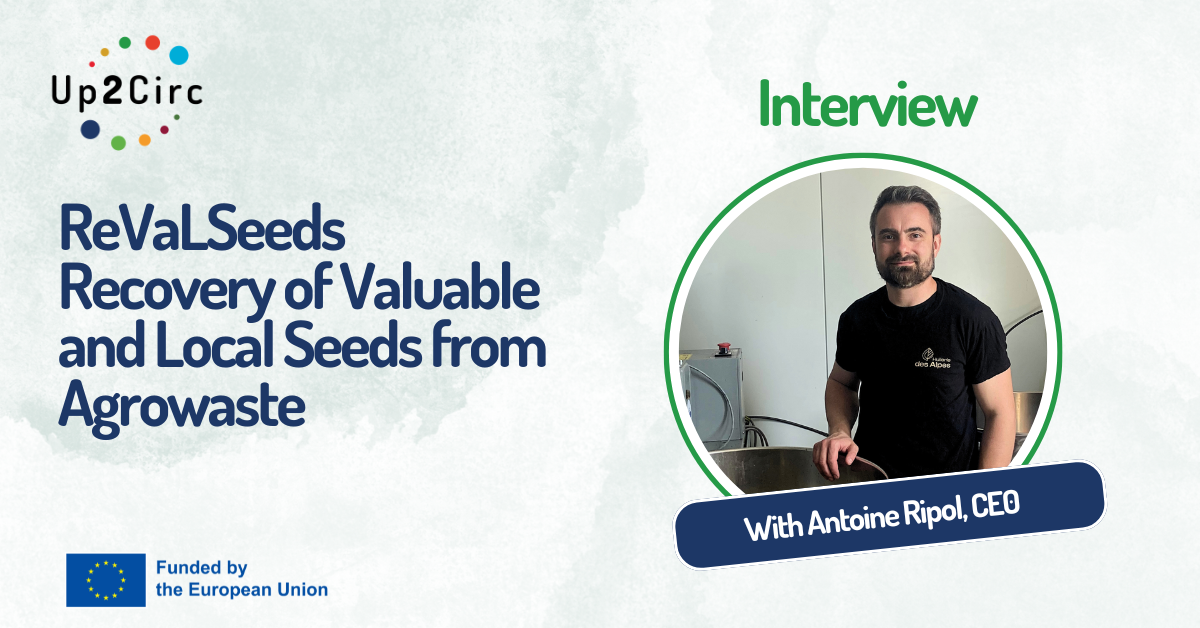
Huilerie des Alpes
Antoine Ripol, CEO
Food
France
PROJECT SCOPE
Feasibility study to develop a low-energy / low-water system to extract seeds from waste streams, and create high-value oils for food and cosmetics.
CIRCULAR BUSINESS MODEL
Circular supply chain
Recovery and recycling
Company and project background
Huilerie des Alpes is a young oil mill based in the French Alps, producing high-quality organic vegetable oils from locally sourced seeds. Our core activity is cold-pressing seeds such as sunflower, rapeseed, hemp or walnut, supplying both food and cosmetic markets. From the beginning, our approach has been rooted in working closely with local farmers and making the most of what is already available in our territory.
The project we implemented, called ReValSeeds, emerged quite naturally from this mindset. It started in 2024, shortly after the launch of the oil mill, when we began questioning how to better valorise by-products from local agro-industrial activities—especially fruit processing. We identified that many seeds, particularly from grapes, apples and berries, are currently underused or treated as waste, despite their potential to produce high-value oils.
The objective of the project was therefore to explore, in a very practical way, how these side streams could be transformed into new local resources. This involved identifying partners, understanding their processes, testing seed extraction and pressing, and assessing technical, economic and regulatory feasibility.
What motivated you to make your business more circular?
From the beginning, it felt a bit strange to see all these seeds—grape, apple, berries—being treated as waste or just poorly used, while we know they can produce high-value oils. So there’s clearly a values side: trying to make better use of what’s already here, locally, instead of always going further to find new resources.
But at the same time, we’re also realistic. There’s a real market behind it. Some of these oils already exist, especially in cosmetics, and there’s growing interest for organic, traceable, locally sourced ingredients. For a small oil mill like ours, it’s also a way to position ourselves differently, with more specific, higher-value products.
The tricky part is that it takes time. A lot more than we initially thought. You have to test, adapt the machines, understand how each raw material behaves… and that’s not something you can just “plug in” overnight. It’s real R&D work.
And that’s exactly where Up2Circ helped. It didn’t change our direction, but it clearly accelerated things. It gave us the space to actually explore these ideas properly instead of just keeping them in the back of our minds.
So in the end, it’s really a mix: something that makes sense to us, and something that could also become a solid part of our business.
Implementation Process
What were the main objectives of your feasibility study?
The main objective was quite straightforward: to see if these by-products could realistically become new raw materials for us.
We wanted to understand if it made sense on every level—technically, economically, and operationally. That meant identifying potential partners, testing the seeds, evaluating oil yields and quality, and also looking at the constraints: logistics, regulations, seasonality… all the things that, in real life, can make or break a project.
Of course, there was also an environmental intention behind it. The idea is to reduce waste and make better use of existing resources, rather than producing more from scratch. But we didn’t start with a very rigid set of indicators or targets. At this stage, it was more about exploring and understanding than optimising.
That said, we still kept a few simple reference points in mind:
- the volume of by-products that could be redirected into oil production,
- the ability to work with local sourcing,
- and the overall coherence of the process (for example avoiding heavy transport or complex intermediate steps that would cancel out the environmental benefit).
So it wasn’t a purely theoretical or impact-driven study. It was really about confronting the idea with reality—seeing what works, what doesn’t, and what would need to change to make it viable in the long run.
What activities did you carry out as part of your project?
We started with a mapping phase: identifying potential partners in our region—wineries, distilleries, fruit processors. The idea was to understand who generates these by-products, in what volumes, and under what conditions.
Then we moved quickly into discussions on the ground. We spent time talking with them to understand their reality—how their processes work, what constraints they have, what is possible or not. That part was key, because on paper a lot of things look simple, but in practice it’s often very different.
In parallel, we carried out technical trials. We sourced different types of seeds—grape, apple, raspberry—and tested them: cleaning, drying when needed, and pressing. This allowed us to evaluate yields, oil quality, and also the behaviour of these seeds with our machines. We also had quite a lot of exchanges with our equipment manufacturer to adjust settings and better understand the limits.
We also looked at regulatory and logistical aspects, especially for grape pomace, which comes with specific constraints. That helped us realise quite early that some options were more complex than expected, and that we needed to rethink how to approach the supply chain.
Throughout the project, we didn’t really separate things into “departments”—we’re a small team—so it was very transversal. But we did involve a range of external partners: processors, distilleries, technical contacts, and of course the machine manufacturer. Their input was essential to move forward in a realistic way.
What feedback did you receive from stakeholders (customers, suppliers etc.)?
On the supplier side—wineries, distilleries, fruit processors—there was real interest, but also a lot of practical constraints. People generally liked the idea of better valorising their by-products, but in reality, their priority is to keep their operations simple and secure. So as soon as it adds complexity, timing issues, or regulatory uncertainty, it becomes more difficult.
For example with grape pomace, we quickly realised that beyond the interest, there are strong constraints: legislation, existing contracts with distilleries, and the very tight harvest period. That forced us to rethink our approach quite a bit. Initially, we imagined something more flexible, but in practice, we had to accept that working during harvest means being ready for a very intense, short window.
With fruit processors, the feedback was often more open. Some were quite interested in finding outlets for their seeds, especially when volumes are significant. But here again, it raised technical questions—cleanliness of the seeds, consistency, preparation before pressing—which made us realise that not all seeds are as easy to work with as we first thought.
On the customer side, especially in cosmetics, the reaction is clearly positive. There is a strong sensitivity to local, circular, and traceable ingredients. That confirmed that there is a market, but also that expectations on quality and consistency are high.
So yes, we did adapt along the way. Probably the main shift was moving from a quite broad idea—“let’s recover seeds locally”—to something more focused and realistic: identifying a few relevant entry points, like distilleries or certain processors, and accepting that building a real supply chain will take time.
In the end, the feedback helped us stay grounded. It didn’t slow the project down—it just made it more concrete.spond to your circular initiatives? Did you adapt your approach based on their feedback?
Impact & Outcomes
What are the main results and outcomes of the project for your company?
At the start, we had the intuition that these by-products—grape, apple, raspberry seeds—could be interesting. Today, we have a much clearer view of what could actually work, and under which conditions. We’ve identified a few realistic supply options, carried out first pressing trials, and better understood the technical constraints linked to each type of seed.
We also now have a clearer picture of where the real opportunities are. For example, raspberry seeds look very promising in terms of positioning and differentiation, while grape seeds seem more accessible through existing players like distilleries. Apple seeds are interesting too, but still require more work to reach something operational.
At the same time, the project highlighted quite a few gaps and challenges.
On the supply side, it’s not as simple as “there is waste, so we can use it”. There are regulatory constraints, existing contracts, seasonality, and also the fact that many operators work at a very small scale or with processes that are not adapted to what we need.
On the technical side, we realised that pressing these kinds of seeds is more demanding than expected. Cleaning, drying, machine settings… there’s still a learning curve for us.
And finally, there’s a structural question: whether we should invest ourselves in certain steps (like seed cleaning and sorting), or rely on partners to do it upstream. At our current size, that’s still an open question.
Did you detect a positive impact of circular transition for your company and for the environment?
At this stage, we’ve made sure to keep things consistent in the way we approach it:
- prioritising local sourcing,
- keeping processes as simple as possible,
- avoiding unnecessary transport or heavy transformation steps.
So even if the impact is not fully quantified yet, the overall direction is very positive. And now that we have a clearer model, the next step will be to go further—both in scaling it up and in measuring its real environmental benefits more precisely.
Which changes have you already implemented?
On a practical level, we’ve carried out first trials, adjusted some of our processes, and begun to identify what would be needed to go further. But we’re not at the stage of large-scale implementation yet.
There are still a few open questions—especially around organisation, equipment, and how to structure the supply chain in a reliable way. These are not things you solve overnight.
So yes, things are moving, but step by step. The project gave us a solid base, and now it’s more about taking the time to build something that actually works in the long run, rather than rushing into something too quickly.
Lessons learned
What key lessons did you learn regarding circular innovation?
One of the main lessons is that circular ideas are often simple on paper, but much more complex in reality.
What we learned very quickly is that everything depends on the context: the partner, their process, the timing, the volumes. There’s no “standard solution” you can apply everywhere. You really have to adapt case by case.
Another key point is the importance of taking the time to talk and listen. A lot of constraints are not technical, but organisational or even contractual. Without these discussions, we would have missed some important blockers early on.
We also realised that logistics and timing are critical. Working with agricultural by-products means dealing with very short and intense periods, especially for things like grape harvest. If you’re not ready at the right moment, you simply miss the opportunity.
And finally, on a more internal level, we learned that this kind of project requires patience. It’s not just about having a good idea—you need time to test, adjust, and sometimes rethink your approach completely.
Did you encounter any challenges?
There were technical and logistical constraints. For example, with grape pomace, we had to deal with regulations, very short time windows during harvest, and the fact that the material can’t be stored for long. It’s a very specific context that requires being ready at the right moment.
We also faced some delays on equipment, which limited our ability to run trials at the scale we initially planned. It didn’t stop the project, but it definitely slowed things down and required us to adapt. Another challenge was the diversity of situations on the ground. Each partner has their own way of working, often with small volumes or specific processes, which makes it difficult to standardise anything quickly.
If you could do your project again, what would you do differently?
We would clearly start earlier in the year to be fully ready for the key periods, especially harvest. A lot of what we do depends on very short windows, and if you’re not prepared at that moment, you lose valuable time.
Another point is that we would probably focus faster on the most relevant partners. At the beginning, we explored quite broadly—which was useful—but we quickly realised that not all sources are equally viable in terms of volume, consistency or ease of processing.
Future plans & recommendations
What are your next steps towards circular transition?
The idea now is to prioritise the most promising opportunities—both in terms of supply and market potential—and push them further instead of trying to do everything at once. Some streams clearly stand out, like grape seeds through distilleries or raspberry seeds with specific partners, so it makes sense to start there.
Is there any advice you would give to other SMEs looking to implement a circular project?
It’s easy to have a good idea on paper, but the real challenge is making it work in real conditions. So go and talk to people early—suppliers, partners, customers—and try to understand their reality before going too far.
Also, don’t underestimate the time it takes. Circular projects often involve a lot of testing, adjustments, and small iterations.
Finally, try to focus on a few concrete opportunities rather than spreading yourself too thin. It’s better to make one thing work properly than to explore too many things without really moving forward.
How can policymakers or financial institutions better support businesses in adopting circular practices?
These kinds of projects don’t fit well into very rigid frameworks. You often need time to explore, test, adjust… and sometimes rethink parts of the project along the way. In our case, for example, the outcomes were not exactly what we initially expected—but the fact that this was accepted made a real difference. This kind of flexibility is a real strength and gives projects like ours a much better chance to succeed.
Do you have any additional comments or reflections about your participation in the Up2Circ project?
It was a very useful experience for us. It helped us take a step back, structure our thinking, and move forward on a topic we had in mind for a while but hadn’t fully explored yet.