
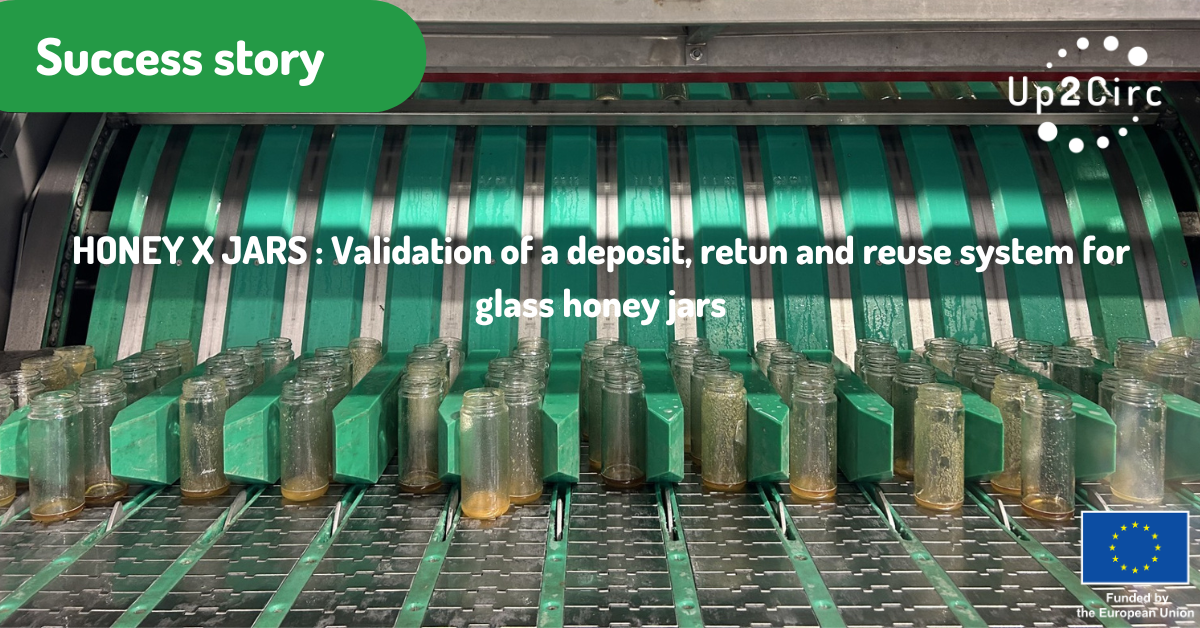
Feasibility study to design and validate a circular deposit-return system for glass honey jars.
COMPANY NAME
COUNTRY
Spain
SECTOR
Agrifood
CIRCULAR BUSINESS MODEL
Product Life Extension
CHALLENGE
This project was launched to address major challenges in the honey and agri-food sector regarding the environmental and economic impact of single-use glass packaging. The current linear consumption model leads to high carbon emissions from glass production and transport, as well as to large amounts of glass waste. Furthermore, a drastic increase in glass prices—up 45–60% between 2019 and 2022—and the strong dependency on imported containers increase costs and expose producers like Tesela Natura to supply chain risks.
SOLUTION
Through the Honey X Jars project, the company has designed and validated a circular deposit-return system for glass honey jars. The system involves the collection of used jars through a network of return points located in the cities of Badajoz and Madrid, complemented by a nationwide online sales channel operated by a Madrid-based client. Once collected, the jars are sent to a specialised operator for professional industrial cleaning to meet food safety standards, after which they are reintroduced into the production cycle.
CIRCULAR ECONOMY STRATEGIES/BUSINESS MODEL IMPLEMENTED
The H x J project has successfully implemented several circular economy strategies:
- Narrow – Resource efficiency: reducing the demand for virgin raw materials, energy, and water associated with primary glass production.
- Slow – Product life extension: maximising the functional lifespan of high-quality glass jars by enabling multiple uses through industrial washing.
- Close the loop: reintroducing glass jars into the production cycle after use, avoiding single-use disposal and waste generation.
- Circular incentive strategy: Implementing a €0.50 economic incentive per jar returned to reinforce customer loyalty and retailer engagement.
- Market Differentiation: The model strengthens Tesela Natura’s position as a sustainable brand, creating new commercial opportunities in market segments that prioritize environmental responsibility.
IMPACT
The Honey X Jars initiative has delivered validated environmental, economic, and social benefits for Tesela Natura.
Environmental impact:
- Successful reuse of jars during the pilot phase, achieving a certified reduction of 70 kg CO₂equivalent and 96 jars reused in 1 operational loop.
- Reduction of glass waste, thanks to the glass jars reused.
Economic impact:
- Confirmed economic viability at system level, with unit costs expected to decrease as collection volumes scale.
- Strengthened brand positioning and the generation of new commercial opportunities in sustainable market channels.
Social impact:
- High consumer acceptance and active engagement from retail partners in different territories and online channels.
- Reinforcement of professional roles and local functions in logistics, industrial cleaning, and value chain coordination.
- Local development, especially in the rural environment
KEY TAKEAWAY
The project proves that transitioning from a linear to a circular reuse model is both technically and economically feasible in the honey sector, providing measurable environmental benefits and enhancing business competitiveness through sustainable innovation.