
COMPANY NAME
NINETY
COUNTRY
France
SECTOR
Electronics Refurbishment
CIRCULAR BUSINESS MODEL
- Circular supply chain
- Product life extension
- Recovery and recycling
CHALLENGE
Most players in the smartphone refurbishment industry prioritize volume over impact, replacing defective parts with new ones imported overwhelmingly from China. In the French market, there are very few suppliers of refurbished or used spare parts — yet this is a critical link for establishing a 100% circular value chain. The supply of refurbished spare parts represents less than 1% of the total market offering, and the market is young and poorly structured. Ninety Two identified this gap as a strategic opportunity to build the first structured market for refurbished smartphone spare parts in France, reducing dependence on new imported parts and enabling a truly circular short-circuit value chain.
SOLUTION
Ninety conducted a comprehensive feasibility study — combining a market study, an impact study, and a technical feasibility study — to identify and validate a circular refurbishment model for smartphone spare parts.
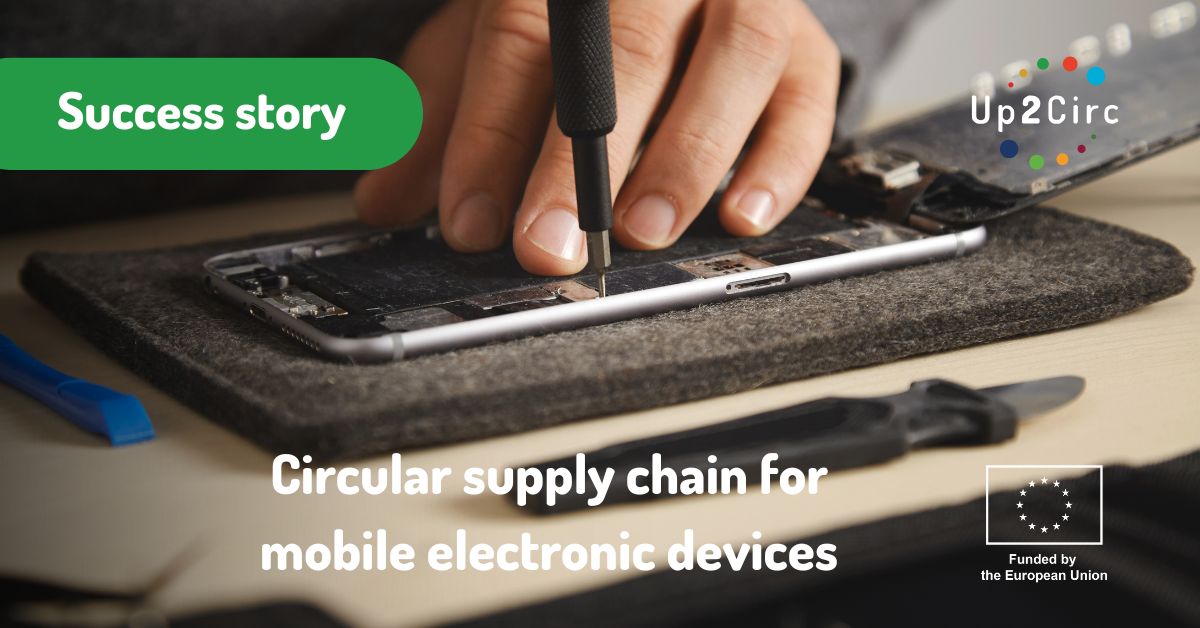
The study identified four high-value spare parts for refurbishment: screens, chassis, motherboards, and camera modules. Rather than creating a sales market (too immature), the most viable and impactful model is to offer refurbishment services directly to wholesalers and professional partners who lack these technical capabilities.
This approach enables Ninety to leverage its existing network of professional partners (refurbishers, distributors, marketplaces) who continuously generate streams of defective but repairable smartphones. The refurbishment processes developed — including micro-soldering, optical calibration, and screen glass separation — are currently mastered by very few actors in France. The business plan confirms profitability from year one.
CIRCULAR ECONOMY STRATEGIES/BUSINESS MODELS IMPLEMENTED
• Product life extension: refurbishment of used spare parts (screens, chassis, motherboards, cameras) to restore them to original quality, avoiding the production of new components.
• Short-circuit supply chain: sourcing waste flows from existing professional partners, reducing dependence on imports from China and creating a local circular value chain.
• Resource efficiency: transforming end-of-life smartphone components into high-value spare parts, preserving rare and critical materials (copper, gold, tantalum, cobalt, platinum).
• Circular service model: offering refurbishment-as-a-service to wholesalers and repair networks, scaling an informal practice into a structured and profitable market.
• Skills development: building local technical expertise in advanced refurbishment techniques (micro-soldering, screen glass repair, optical calibration) currently mastered by fewer than 10 people in France!
IMPACT
ENVIRONMENTAL IMPACT
• A refurbished smartphone generates 8 times less environmental impact than a new one, saving 79 kg of CO₂ per device (−87%).
• Screen refurbishment: 25–35% of total GHG savings of a new smartphone.
• Motherboard refurbishment: 40–50% of total GHG savings (highest impact — chip manufacturing).
• Chassis refurbishment: 10–15% of total GHG savings (avoids new metal/plastic production).
• Camera refurbishment: 5–10% of total GHG savings.
• Significant preservation of rare materials: gold, cobalt, tantalum, copper, platinum.
ECONOMIC IMPACT
• Business plan confirms profitability from year 1 of operations.
• Total project budget: 20,088.16 € (personnel + overhead), fully within budget — no deviations.
• Demand for refurbished spare parts is growing at double-digit rates, driven by economic imperatives and strong EU regulatory support (Right to Repair).
• Equipment investment required: approx. 64,005 € total across all four part types (screens: 45,465 €, chassis: 6,900 €, cameras: 5,820 €, motherboards: 5,720 €).
SOCIAL IMPACT
• Creation of local, skilled technical jobs in micro-soldering, screen repair, and optical calibration — skills currently scarce in France.
• Contribution to SDG 8 (Decent Work and Economic Growth) through structured, qualified employment.
• Reduction of dependency on imported components, strengthening local value creation and a more resilient circular industrial ecosystem.
KEY TAKE AWAY
Ninety’s feasibility study demonstrates that refurbishing smartphone spare parts (screens, chassis, motherboards, cameras) is both technically viable and economically profitable from year one. The circular refurbishment service model — targeting wholesalers and professional repair networks — addresses a real, growing market gap in France, where supply of refurbished parts remains below 1% of the total market.
By transforming waste flows from its network of partners into high-value spare parts, Ninety creates a 100% circular, short-circuit value chain that delivers significant environmental savings (up to 87% CO₂ reduction per device), preserves critical raw materials, and creates skilled local jobs in advanced refurbishment techniques currently mastered by fewer than 10 people in France.
The next steps are: equipping the workshop with the necessary machinery, training teams in innovative refurbishment processes, and launching a pilot offer with an identified professional partner.